In the late 19th century, Argentina was one of the world’s fastest-growing economies at the time, thanks to agriculture and exports (especially beef and wheat). The country had low population density and needed laborers for railroads, farming, and urban development. Argentina actively encouraged European immigration to populate and develop the country (e.g., Law 817 in 1876, see next). As more Italians settled in Argentina, new arrivals found familiar communities and support networks. Between 1870 and 1920, over 2 million Italians moved to Argentina. By the early 20th century, Italians made up a third of Buenos Aires’s population. Italian culture heavily shaped Argentine cuisine (pizza, pasta), language (Lunfardo slang), and surnames. Many Argentinians today are of Italian descent—some estimates say up to 60% have at least one Italian ancestor.
Law 817 (1876)
This law passed to promote European immigration as a way to populate Argentina’s vast rural territories and boost the economy. To develop agriculture and create productive colonies in underpopulated areas. Provisions of the law included:
· Guaranteed free or subsidized passage for immigrants from Europe.
· Offered temporary housing and food upon arrival.
· Promised land grants or access to colonization programs for families willing to farm.
· Protected immigrants from discrimination and granted certain legal rights.
The law specifically encouraged white, European immigrants, in line with the then-prevailing racial and cultural biases. It also barred people considered “undesirable”, such as those with criminal records or deemed mentally ill.
This law resulted in mass immigration from Italy, Spain, Germany, France, and Eastern Europe. Between 1880 and 1930, over 4 million Europeans immigrated to Argentina.
This photo shows hundreds of Italian immigrants disembarking at the port of Buenos Aires in 1907:
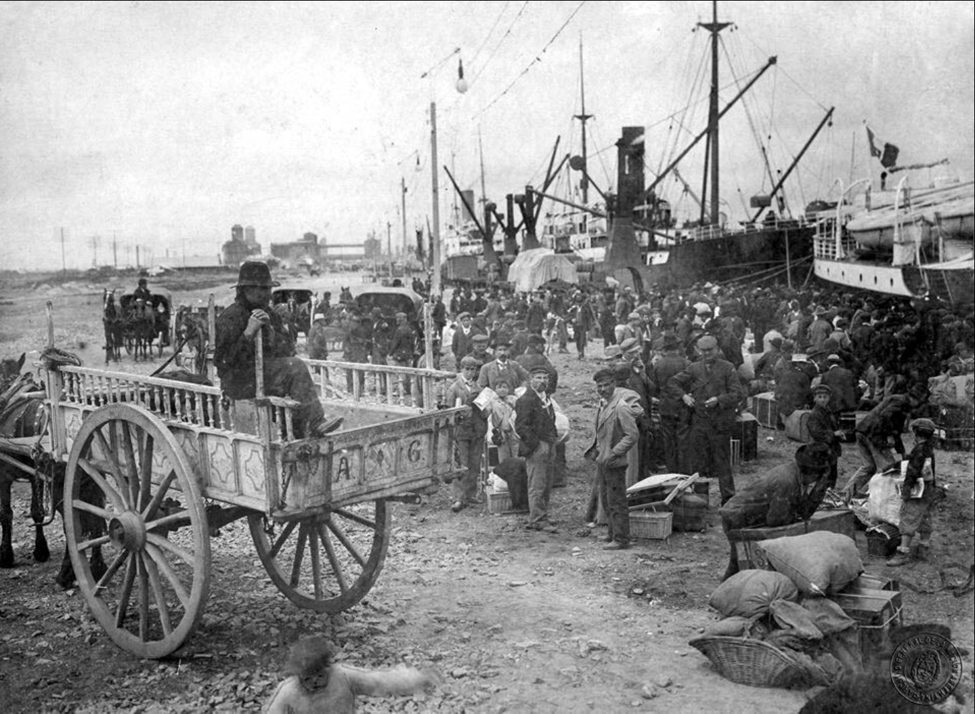
Argentina enjoyed an economic golden age in the years 1880 to 1930. It was one of the richest countries in the world. Around 1913, Argentina had one of the highest per capita GDPs globally—comparable to or even exceeding countries like Germany, France, and Italy at the time.
Buenos Aries was known as the “Paris of South America,” with grand architecture, opera houses, and modern infrastructure.
In the early 20th century, Argentina’s per capita GDP was nearly equal to that of the United States, with real wages approaching those in Britain. The phrase “riche comme un Argentin” (rich as an Argentine) was used in France to describe extreme wealth during this period. During the 1930s, the US, Canada, Australia and Argentina remained among the richest countries in the world
Meanwhile, Italy was deeply divided and rural poverty was widespread, especially in the south (like Calabria and Bari). Wages for laborers in Argentina were often higher than in Italy. The vast Pampas offered hope for land ownership or steady farm work. Argentina marketed itself as the “United States of the South.” While average GDPs may have looked similar on paper, real-life conditions for many Italians — especially in the south — were dire. Argentina offered them hope, work, and dignity. Over 2 million Italians moved there between 1870 and 1930, reshaping the country’s culture and demography.
After these 50 years of great prosperity, Argentina economic gradual decline started and never stopped, and after ~ 1950 the decline accelerated. The following chart shows the dramatic economic stagnation of Argentina compared to other developed countries. Prior to 1950, Japan lagged behind Argentina, but after 1950 it quickly overtook Argentina and kept growing much faster.
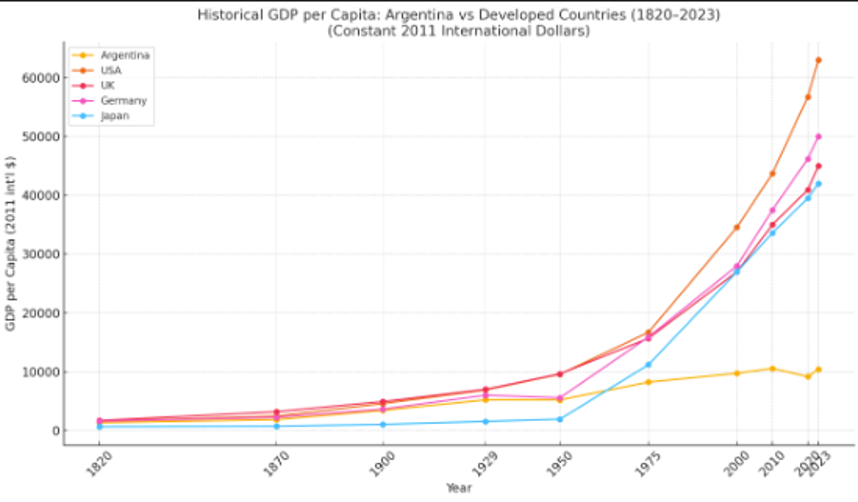
Source: https://www.rug.nl/ggdc/historicaldevelopment/maddison/
Argentina went from having a GDP per capita within the top 10 countries in the world to ~ 70th in the world, as shown in the following table.
| Year | Approx. Global Rank | Notes |
| 1913 | 7th–10th | One of the richest countries; major food exporter; booming immigration. |
| 1930 | ~12th–15th | Still wealthy, but impact of global depression and early signs of stagnation. |
| 1950 | ~20th | Post-WWII: many countries industrialized faster; Peronism rises. |
| 1970 | ~25th–30th | Relative decline continues; recurring inflation and political instability. |
| 1990 | ~40th–45th | Economic crisis, hyperinflation, and debt. |
| 2001 | ~60th–65th | Massive debt default; economy crashes. |
| 2010 | ~55th–60th | Recovery during commodity boom; temporary improvement. |
| 2024 | ~66th–70th | Chronic inflation, currency devaluation, and unstable macroeconomy. |
| The causes of this decline are complex and multifaceted. In the 1930s, a military coup ends 70 years of democracy. The Great Depression hits global trade, and Argentina’s export model collapses leading to a rise of economic nationalism and turning inward, with increasing state intervention. The decline continued during in the 1950s, with populist and protectionist policies, nationalization of industries, heavy state spending, and rising inflation. Violent military dictatorships in the 1970s, economic mismanagement, hyperinflation, stagnation, and rising debt. The return of democracy in the early 1980s brought human rights relief but did little to slow the economic decline, inflation reached +3,000% annually in 1990 and the economy collapsed in the 2000s with a massive default on debt, banks froze accounts, poverty crossed the 50% point. After a temporary boom, populist policies return, and high inflation continued into the 2020s. Argentina’s 20th century path serves as a cautionary tale about how a wealthy country can lose its way. |
By mid-June 1985, monthly inflation was accelerating to nearly 3% per day, prompting the government to implement the emergency stabilization plan. 1985 Inflation was 672%